
From Innovation to Evidence: Raising the Bar in Licensing
JP Hong, Qualcomm Inc. – Keynote Speaker
LES Annual Meeting 2026, Monday, Oct. 19, San Diego, CA
JP Hong, VP of Licensing at Qualcomm, opened the LES Annual Meeting with an entertaining and informative keynote address. Through engaging stories and practical examples, he offered an inside look at the licensing strategy behind one of the world’s largest patent portfolios.
Founded in the 1980s and headquartered in San Diego, Qualcomm develops cellular, Wi-Fi and computer chips used in products ranging from smartphones and automobiles to computers and data centers. But as Hong explained, technology development is only part of the company’s business.
“The other big part of our business that is not as well-known is our licensing program, QTL Qualcomm Technology Licensing. We have probably one of the biggest patent licensing programs in the world.”
Building IP
Qualcomm has operated its patent licensing program for 35 years, covering successive generations of cellular technology, from 2G through 5G, with 6G on the horizon. Each new generation brings additional technology development and opportunities for license renewals.
Hong shared some impressive numbers: 23 billion licensed devices shipped and more than 90% of global 3G, 4G and 5G handsets covered by Qualcomm licenses. The program generates more than $5 billion in annual licensing revenue.
So, how has Qualcomm built such a successful licensing business?
Hong posed the question himself before offering a straightforward answer: “You must have foundational patents. You also have to spend a lot of money on R&D, $115 billion dollars or more. That works out to be on average 20 percent of our annual revenue on R&D, and that’s how.”
He also emphasized the importance of taking risks and investing for the long term. Developing foundational technology requires patience, substantial resources and a willingness to pursue ideas that may take years to reach the marketplace.
“It might be 5 or 10 years before you even see your first product. But you also need to prove that the technology works and that it can be commercialized, that it can be implemented at scale.”
Licensing Principles
Qualcomm’s licensing strategy rests on three principles: transparency, consistency and fair pricing. Hong stressed that these principles apply equally to public statements and private negotiations.
“What we say publicly, we also say privately. Our biggest licensing program is the 5G handsets and our rate is 3.25 percent of your net selling price. So if the handset price is $100, it’s $3.25 for the license. For automotive, we have a fixed rate of $5 per vehicle and this is on our website.”
The company stands by its published rates during negotiations. Hong explained that offering different rates to different licensees can undermine trust and the credibility of the entire licensing program.
Consistency also extends to licensing terms, which typically cover five to seven years. Qualcomm takes a global approach to licensing rather than negotiating separate arrangements for individual regions.
6G Outlook
Looking ahead, Hong described 6G as an evolution of the foundational technologies established by 5G, with artificial intelligence playing an increasingly important role. AI applications will create new demands on network uplink capacity and require additional capabilities.
The growing number of connected devices—from smartphones and computers to wearables—will further increase demand for cellular connectivity. Hong also pointed to emerging applications that could drive 6G development, including robotics, autonomous vehicles, drones and data centers.
Hong closed by reinforcing the importance of continued innovation and a consistent approach to licensing.
“Qualcomm will continue to innovate and create foundational patents and will rely on the three principles I discussed: transparency, consistency, and fair pricing to continue our success.”
Bio: JP Hong is Vice President of Business Development at Qualcomm Technology Licensing (QTL), a division of Qualcomm Incorporated. QTL shares breakthrough inventions through global patent licensing programs and enables technology partners to deliver compelling products that transform consumers’ lives. In this role, JP is responsible for licensing Qualcomm’s patent portfolio to companies worldwide. Prior to joining Qualcomm, JP spent a decade in private practice at leading US law firms, focusing on patent litigation and prosecution. He subsequently spent more than ten years at Samsung Electronics, where he managed IP strategy and risks for the company’s semiconductor and consumer electronic businesses. As Vice President within Samsung’s IP Center, JP managed a broad portfolio of patent licensing and dispute matters across all areas of IP. He directed litigation and settlement strategies for hundreds of disputes worldwide, successfully negotiating numerous high-profile agreements and resolutions. He worked closely with senior business leaders on strategic decision-making and led significant patent acquisitions to support emerging technologies and strengthen Samsung’s global patent portfolio. JP holds a Bachelor of Arts in Physics and Government from Bowdoin College, and a Juris Doctor from Boston College Law School.
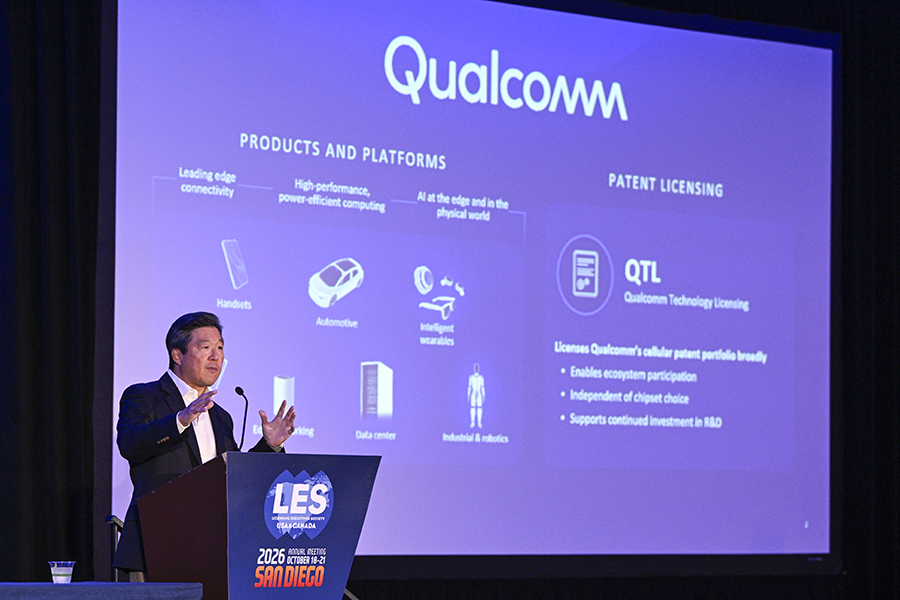
JP Hong opens the LES Annual Meeting in San Diego, describing Qualcomm’s semiconductors and licensing program.

Get Social